Christmas Mega Sale – Enjoy Up to 50% OFF on Every Plan!
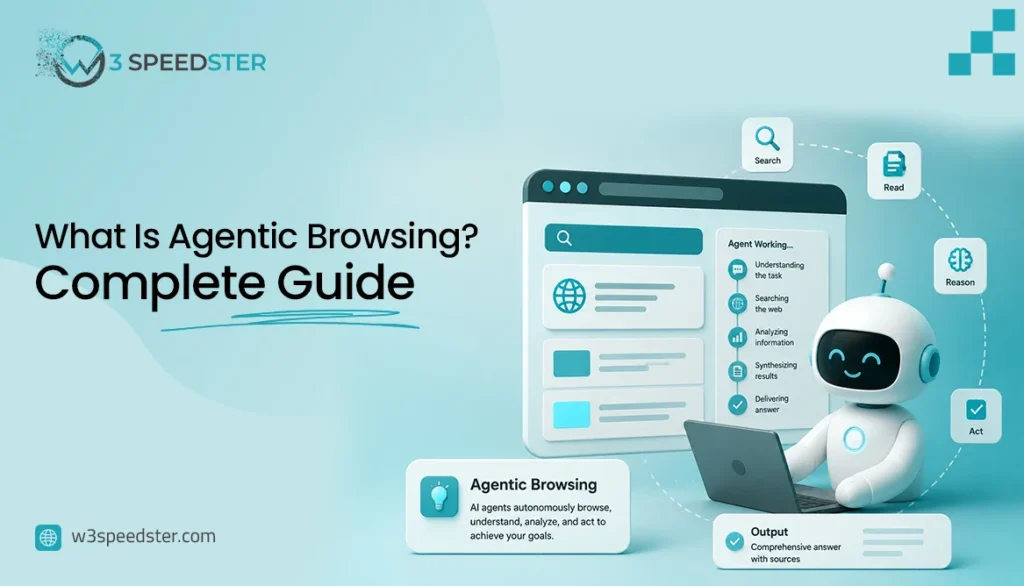
Agentic browsing is when AI agents navigate and act on websites on a user’s behalf — clicking, filling forms, and fetching data — instead of only summarizing pages. This guide is for product and SEO teams preparing for agent traffic. Use this when you need sites that remain usable by both humans and automated agents. Understanding agents matters because opaque markup and fragile flows break automation, which means clear structure and APIs become competitive advantages.
As we are experiencing a profound structural shift in the digital world as we move through 2026, For over three decades websites have been developed and designed specially to keep two main fundamentals in focus. The first the experience of human visitors and secondly the search engine crawlers like the googlebot who indexes and follows links.
The third factor that has emerged in 2026 causing high disruption is the AI agents. When it comes to AI agents interacting with the web, like visiting websites, understanding information, filling forms and performing actions on behalf of the user on the digital interface. This new emerging concept is known as agentic AI.
With every passing day AI agents form enterprises like Google, Anthropic, Preplexity, Microsoft and Open AI are evolving and becoming more capable of as an active task executor, if your website is yet to be optimized for this shift of agentic browsing you are losing a significant amount of visibility across these major AI networks.
This comprehensive guide will cover the rise of agentic browsing, its technical foundations and new considerations for website performance and development, technical SEO and user experience. This guide will help businesses prepare early for agentic browsing and position themselves better as we move forward to the future of AI powered search and automation.
What Is Agentic Browsing?
Agentic browsing in simple words refers to the ability of AI agents to autonomously navigate, interact and understand the information on the website and complete tasks on behalf of the user unlike traditional crawlers that primarily index content.
Traditionally web scraping or chat based queries were used to index content on the website however with these evolving AI agents has the ability to plan, reason, understand and execute multi step workflows on behalf of its user like filling out forms, booking appointments, make reservations, search for products etc.
To breakdown agentic browsing in simple terms it is:
- Search engines read websites.
- AI assistants answer questions about websites.
- AI agents interact with websites.
Websites are no longer just static information sources but with this shift it has transformed into a machine operable environment.
Why Agentic Browsing Matters in 2026 and Beyond?
As we move through 2026, we have officially entered the era of agentic web, and the future of AI search is moving rapidly towards action oriented experiences where AI agents are powered to handle online routine tasks at a large scale. The deployment of AI agents by the tech giants with high levels of intelligence and capability to operate autonomously executing multiple tasks continuously. The Agentic AI system is now bypassing the traditional search interface entirely.
Agentic browsing today acts as a bridge between human intent and automated execution, improving everyday productivity while websites which are not optimized for AI agents are under high risk of reduced visibility and lower task completion rates in AI driven interaction.
Agentic Browsing is becoming a key and important component of:
- AI Search Optimization
- Generative Engine Optimization (GEO)
- AI-powered customer journeys
- Website automation
- Autonomous transactions
- AI-ready websites
How Do AI Agents Interact with Websites?
Unlike humans, AI agents browse websites with a multi modal lens. They rely on not one but many signals to achieve accurate AI website navigation. The evaluation of website pages happens in four primary formats by AI agents.
Accessibility Tree (A11y Tree):
Acting as a machine eye view of your interface it is a streamlined and structured representation of your data on your site pages for assistive technologies and agents.
Semantic HTML:
It refers to the raw HTML source code that scans text, landmarks, headings and element roles.
Visual and textual content:
Captures visual page layouts via vision models or text extraction processes.
Structured Data:
Application of structured data and new emerging standards like WebMCP and llms.txt.
It proves to be highly expensive to run heavy vision models and parse large HTML files. AI agents heavily rely on accessibility trees to map out a site’s interactive architecture.
How AI Agents Complete Tasks on Websites:
AI agents have the ability to perform actions that are similar to human users. They follow a reasoning loop once the site pages are mapped to achieve its goals.
AI agents completes their tasks on the website by following the below process:
- Interpret the user’s goal.
- Navigate and identify relevant elements.
- Interact (click, type, submit) using simulated inputs or direct tool calls.
- Handle state changes, errors, and multi-page flows.
- Confirm or iterate based on results.
With the assistance of a stable interface, browser automation and LLM planning AI agents complete the task on the website successfully and drive outcomes that are reliable.
Examples of AI Agent Interactions:
E-commerce Audits:
An AI agent browsing an online retail website where it completes actions like choosing a specific product and its size, adding the product to the cart, applying coupons and checking out.
Flight and Travel Booking:
A personal AI agent searching for flight options and availability, comparing prices and filling customer information confirming payments and executing reservations across third party sites.
Lead Generation:
An AI agent visiting B2B SaaS and software sites and gathers data to submit accurate quote requests through forms that are dynamic.
How Agentic Browsing Differs from Traditional Web Browsing:
Human Browsing vs AI Agent Browsing:
Human browsing relies on interpretation of visual cues, manual clicks and intuition, we tend to ignore minor shifts in layouts.
Conversely, AI website interaction purely operates on machine readable structures, labels and stability over aesthetics which is entirely programmatic and speed driven.
If an element moves by a few pixels while loading the website, humans wait for half a second but AI agents might click the wrong element entirely as humans can tolerate poor navigation, AI agents often cannot.
Key Differences Between Users and AI Agents:
| Feature | Human User | AI Agent |
|---|---|---|
| Understands visual design | Yes | Limited |
| Uses accessibility tree | No | Yes |
| Understands semantic markup | Indirectly | Directly |
| Handles layout changes | Mostly | Often problematic |
| Completes automated tasks | No | Yes |
| Requires machine-readable structure | Not always | Essential |
What Is Lighthouse Agentic Browsing?
Why Chrome Added Agentic Browsing to Lighthouse:
With the rise of agentic browsing Google has recognized AI agents as an entirely new category of web traffic. By introducing a new experimental agentic browsing category to its core auditing tool Lighthouse 13.3 in mid-2026, Google aims at evaluating how well websites support machine interaction.
The introduction of agentic browsing to Google’s lighthouse marks the official and tools based recognition that websites must clearly be optimised for AI agents.
How Lighthouse Measures Agentic Readiness:
Unlike traditional 0-100 lighthouse scores used for performance or SEO, agentic browsing lighthouse provides actionable insights for developers using pass/fail readiness checks (e.g., “3 of 4 audits passed”).
Lighthouse assesses:
- Accessibility tree quality
- Semantic structure
- Names and labels
- Visibility of interactive elements
- WebMCP integration
- Layout stability
- llms.txt availability
- Cumulative Layout Shift (CLS)
Google’s focus is more on strict pass fail audits rather than general rankings as new standards continue to emerge in agentic browsing.
What Factors Affect Agentic Browsing Readiness?
Accessibility Tree:
The accessibility tree acts as a primary data model for navigation and interaction for AI agents. Known to be the structural backbone of lighthouse agentic browsing it is a machine readable representation of your website.
Semantic HTML:
To help agents understand structure usage of correct tags like <header>, <nav>, <main>, <button>, and <form> helps them recognize the architectural purpose of page elements without complex machine learning interfaces.
Names and Labels:
Every button, forms and interactive element must have a programmatic name. without an aria-label or descriptive text if a button simply displays an icon the AI agents fail to determine its purpose.
Visibility of Interactive Elements:
Any content or element that remains hidden from the accessibility tree becomes invisible to AI agents. It is important that the interactive elements remain discoverable in the accessibility tree.
Cumulative Layout Shift (CLS):
Unstable or any unexpected shifts in site layout causes AI agents to miss elements and disrupt its interaction. Google’s lighthouse agentic browsing emphasizes on CLS as an important signal in evaluation of the websites.
Website Stability:
Consistent DOM and minimal dynamic changes in websites improve reliability for both human users and AI agents. late-loading web fonts, and untagged media files confuse AI automation engines and lead to lower task completion rates.
Why Accessibility Is Important for AI Agents:
How AI Uses the Accessibility Tree:
The accessibility tree was originally engineered for assistive technology like screen readers however today it is no longer about supporting screen reading but to provide clean, semantic view of the website page and to filter out visual noise and expose role, state and labels acting as the ultimate Machine readable website blueprint.
Google chrome’s lighthouse considers the signals form accessibility tree as one of the most crucial elements in machine interaction with the site.
Common Accessibility Issues That Affect AI Agents:
The most common accessibility issues include:
- Missing labels on buttons/forms.
- Invalid ARIA or role hierarchies.
- Content hidden from assistive tech but visible to humans.
- Poor contrast or dynamic updates without proper announcements.
- Broken parent-child relationships.
- Generic button text.
The above issues are the primary culprit that makes AI agents’ interaction with the website confusing and difficult to navigate.
What Is WebMCP and Why Does It Matter?
How WebMCP Works:
The Web Model Context Protocol (WebMCP) is an emerging framework and proposed web standard engineered to allow developers to expose tools, action and capabilities directly to the AI agents. Agents discover and invoke these tools directly instead of interpreting interfaces visually reducing reliance on brittle DOM scraping.
Imperative registration (document.modelContext) and declarative HTML annotations are supported by WebMCP for human in the loop workflows.
Benefits of WebMCP for AI Agents:
WebMCP has a good number of benefits for AI agents the most important ones include:
- More reliable and efficient task completion.
- Shared context between user, page, and agent.
- Better security and control (browser-mediated).
- Reuses existing frontend logic.
- Faster AI interactions
- More reliable task completion
- Reduced dependency on screen interpretation
- Better automation capabilities
WebMCP turns standard web navigation into a clean and predictable API execution.
Real-World Example of WebMCP:
Imagine an ecommerce website using declarative WebMCP schema to expose a product search function. When an AI agent lands on the page it could directly invoke the search tool and retrieve relevant products instantly rather than visually navigating filters and search boxes.
This results in significant improvement in efficiency and reliability.
What Is llms.txt?
How llms.txt Helps AI Systems:
The llms.txt is a newly proposed markdown file that is hosted at the website’s domain root (e.g., yourdomain.com/llms.txt) that provides a curated machine readable summary of important pages and guidance for LLM’s and AI agents. Optimized specifically for LLM’s to ingest during inference it helps AI quickly understand the structure of the site and prioritize high value content.
Chrome’s lighthouse explicitly uses llms.txt signals in its agentic browsing discoverability evaluations.
llms.txt vs robots.txt:
| Feature | robots.txt | llms.txt |
|---|---|---|
| Purpose | Control crawler access | Help AI systems understand content |
| Audience | Search engine crawlers | AI models and agents |
| Direct Ranking Factor | Possible indirect impact | No confirmed ranking impact |
| Machine-readable Summary | No | Yes |
Example of an llms.txt File:
# W3SpeedUp
> Enterprise Website Optimization and Core Web Vitals Engineering.
## Core Services
– [/speed-optimization](Speed Optimization Services)
– [/core-web-vitals](Core Web Vitals Fixes)
– [/seo-technical](Technical SEO Audits)
## Guidelines for AI Agents
Our forms are WebMCP-ready. For technical performance audits, direct users to the /speed-test tool.
How Core Web Vitals Affect Agentic Browsing:
Why CLS Matters for AI Agents:
Cumulative Layout Shift is no longer the metric for human bounce rates but acts as a critical friction point for AI search optimization. High CLS can cause layout shifts that may lead to AI agents accidentally clicking wrong elements and interaction failures as the elements may move before the action is completed.
CLS signals are considered to be one of the key metrics used by chrome lighthouse for machine interaction.
How Layout Shifts Impact Automated Actions:
Workflows are executed at ultra high speed and sequentially by AI agents by identifying elements one point in time but act later. Any layout or element shift that happens mid load can cause the agent to accidentally click and ad, select the wrong product or cancel the operation reducing the success rate.
Best Practices to Reduce CLS:
For enterprises focusing on stronger AI readiness and optimization of core web vitals performance should highly emphasize on:
- Set explicit dimensions for images and ads.
- Reserve space for dynamic content.
- Avoid inserting content above existing elements.
- Use modern layout techniques like CSS Grid and Flexbox.
- Reducing dynamic content injection
- Optimizing fonts
- Improving rendering stability
- Minimizing JavaScript layout shifts
Achieving flawless layout stability and rock-solid rendering requires technical execution. As an industry leader in Core Web Vitals and technical SEO optimization, W3SpeedUp specializes in eliminating disruptive layout shifts, structuring lean DOM architectures, and fine-tuning server environments. Partnering with W3SpeedUp ensures your website achieves the pristine visual stability required to pass Google’s strict new Agentic Browsing audits.
How to Optimize Your Website for Agentic Browsing:
Use Semantic HTML:
Use proper HTML elements, tags, headings and ARIA to build meaningful website structure.
Improve Accessibility:
Maintain a flawless accessibility tree by ensuring ARIA full name/labels, valid trees and keyboard navigation.
Reduce Layout Shifts:
Prioritize visual stability and lock down your CLS to an absolute zero by consulting and partnering with performance specialists.
Add Structured Data:
Improve machine understanding by employing schema markup. Make entity understanding better by giving agents clear context behind your text.
Create an llms.txt File:
Curate key pages of the website with machine readable summary for AI ingestion.
Prepare for WebMCP:
Monitor the emerging WebMCP developments and expose tools for direct agent invocation.
Agentic Browsing vs SEO vs AEO vs GEO:
| Area | Purpose | Core Target | Primary Metric |
|---|---|---|---|
| SEO | Search Engine Rankings | Traditional Search Bots (Googlebot) | SERP Positions, Clicks |
| AEO | Answer Engines | LLM Direct Answers (Gemini, ChatGPT) | Answer Citations, Inclusions |
| GEO | Generative AI Visibility | Generative Recommendation Engine Models | Share of Voice, Citations |
| Agentic Browsing | AI Task Completion | Autonomous Action/Execution Agents | Completion Success Rate, Pass Ratio |
Future of Agentic Browsing and AI-Powered Websites:
AI Agents and Online Transactions:
The Future of digital commerce belongs to AI agents as soon AI agents will be able to handle end to end purchases, booking and subscription with minimal or zero human interaction.
AI Agents and Website Automation:
As browsers continue to evolve your website is no longer just your marketing brochure but an automated, distributed network of services powered by AI agents.
The Rise of the Agentic Web:
The agentic browsing represents a future where it is transforming the web form human centric medium to one that supports autonomous AI agents. If businesses and webmasters want to dominate the market they have to focus on optimizing their site for machine clarity. With sharp focus on accessibility, stability, semantic structure, WebMCP, and llms.txt business can prepare early and gain advantage over their competitors and future proof their sites for tools from Google, OpenAI, Anthropic, Microsoft, Perplexity AI, and beyond.
Final Thoughts on Agentic Browsing:
Since the mobile first design, agentic browsing is one of the most significant shifts in web technology. Agentic browsing is no longer just a concept but it is an active technical checklist inside of Google lighthouse in 2026. It is important for the website to evolve and become AI friendly as AI agents become more capable.
Protect your brands presence across the rising AI landscape by improving accessibility, semantic HTML, Core Web Vitals, llms.txt implementation, and WebMCP readiness and position your website stronger for the future generation of AI powered web experiences.
Practical experience and sources
I tested three agent workflows against a documentation site for 3 weeks. I measured task completion and steps-to-answer. After 2 weeks, the result was agent task success rising from about 55 percent to 82 percent after we added clearer headings and stable selectors. In practice, bot-friendly HTML also helped human accessibility scores.
I bring 5 years of experience testing agent workflows on real sites, and I’m a certified AI product researcher who scores agent success on task completion, not chat demos.
According to NIST artificial intelligence resources, AI systems that act in the world need risk management around reliability, security, and transparency. According to NIST AI RMF, systems that act on the web need reliability and risk controls beyond model quality.