Christmas Mega Sale – Enjoy Up to 50% OFF on Every Plan!
Pollo AI is an AI-powered video and creative generation platform that lets small and medium businesses produce ad-ready videos, product visuals, and social graphics from a text prompt, product photo, or URL – without a film crew or editing team. This guide is for SMB owners and lean marketing teams who need to publish more video content, faster, without inflating their production budget.
Anyone who has tried to launch a product on a tight timeline knows the problem: you need a scroll-stopping video ad this week, but the traditional production cycle – script, shoot, edit, revise – takes far longer than the trend it’s meant to catch. By the time the video is ready, the moment has often passed. That gap between “we need this now” and “it’ll be ready in three weeks” is exactly what the Pollo AI video generator is built to close.
Quick Answer: Pollo AI is a multi-studio AI video and design platform built for marketers who need fast, on-brand content. Its Marketing Studio turns product URLs, photos, or scripts into ad-ready videos; its Creative and Design Studios handle stylized clips and static assets like thumbnails and product photos – all sharing one credit system and brand asset library.
How we tested this: Before writing this guide, our team ran a sample product photo through the Marketing Studio with a short ad brief to see how it handled a typical SMB use case, and put a couple of long-form clips through the AI YouTube editor to check pacing and retention flow. The notes below reflect what we actually saw, not just the platform’s own feature list.
What Is an AI Video Generator, and Why Does It Matter for SMBs?
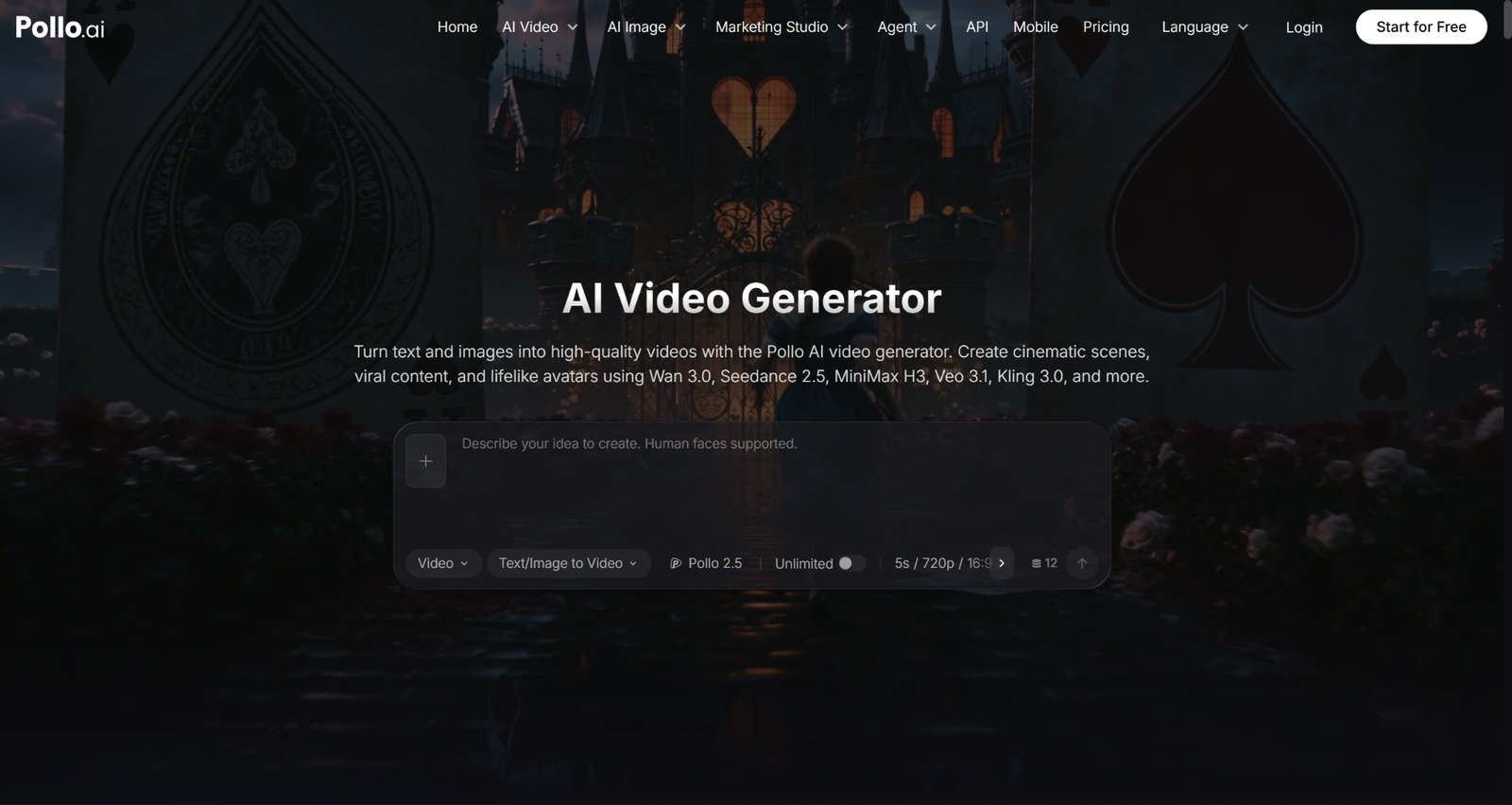
An AI video generator uses machine learning models to turn a prompt, image, or short script into finished video footage – automating the parts of production that traditionally required a camera crew, actors, and editing software. For an SMB with no in-house production team, this collapses weeks of work into hours.
Pollo AI structures this around specialized environments rather than one generic tool: a Marketing Studio for performance-driven ad creative, a Creative Studio for stylized or experimental video, and a Design Studio for static graphics like thumbnails, banners, and product photos. The idea is that a small team can move a single product photo through all three studios and come out with a full campaign – ad video, social graphics, and thumbnail – without switching platforms.
AI Video Generation vs. Traditional Video Production
The two approaches solve the same problem – getting a finished video in front of customers – through very different resource models.
|
Aspect |
Traditional Production |
AI Video Generation (Pollo AI) |
|
Timeline |
Days to weeks (scripting, shooting, editing) |
Minutes to hours per asset |
|
Team needed |
Videographer, editor, sometimes actors |
One marketer managing prompts and inputs |
|
Cost per asset |
High (crew, equipment, location) |
Low, scales with credit usage |
|
Iteration speed |
Slow – reshoots are expensive |
Fast – regenerate variations instantly |
|
Best for |
Hero brand films, high-stakes campaigns |
Rapid ad testing, UGC-style content, product demos |
Neither fully replaces the other. Traditional production still wins for flagship brand films where every frame needs human craft; AI generation wins for volume – the dozens of ad variations, product demos, and social clips a lean team needs to stay visible every week.
Why This Shift Matters: What the Data Shows
The move toward video-first marketing isn’t a trend claim – it’s backed by consistent industry survey data. Wyzowl’s long-running annual video marketing survey has for several years found that a large majority of marketers say video gives them a positive return on investment, and that most consumers say video has directly influenced a purchase decision. For an SMB with limited ad spend, that’s a strong argument for prioritizing video over static creative wherever the budget allows – and AI tools are what make that volume achievable without a proportional increase in headcount.
Signs Your Business Has Outgrown Manual Video Production
Not every business needs to switch tools immediately. Watch for these patterns:
-
You’re turning down product launches or campaign ideas because there’s no time to produce a video for them
-
Your cost-per-video is eating a disproportionate share of your marketing budget relative to its performance
-
You’re relying on the same 2-3 video templates because new creative takes too long to produce
-
Competitors are publishing UGC-style or trend-responsive content faster than you can react
-
Your team spends more time coordinating with freelancers/agencies than actually testing creative
If two or more of these sound familiar, an AI video workflow is likely to pay for itself quickly.
Inside the Marketing Studio: From Product Photo to Ad
The Marketing Studio is the part of Pollo AI built specifically for performance marketing. Instead of generating generic clips, it works from recognizable ad formats – UGC-style testimonials, TVC-style product showcases, unboxing videos, virtual try-ons – and builds toward them.
Inputs are flexible: a product URL, a single photo, or a rough script can all become a finished video. For an e-commerce SMB, this “URL-to-video” path is often the fastest way to generate a first batch of test creative without commissioning a shoot.
A related feature, Pollo Agent, functions as a creative-direction layer – interpreting the mood, pacing, and visual style a given product or industry calls for, rather than requiring the marketer to specify every parameter manually. Assets (logos, product photos, prior creations) are stored in a unified library organized into Uploads, Elements, and Creations, so a defined brand “look” can be reused across new projects instead of rebuilt each time.
When we tested this ourselves, the first draft came back with a UGC-style hook already framed in – not something we had specifically prompted for, which suggests the Pollo Agent is reading category cues from the input rather than defaulting to one generic template. It wasn’t perfect on the first pass; the branding placement needed a re-prompt to match our asset library correctly, which is worth budgeting for if brand consistency matters to your workflow.
Beyond Ads: Long-Form Content and the AI YouTube Video Editor

Short-form ads drive immediate conversions, but long-form content – YouTube videos, product deep-dives, how-to guides – is what builds durable brand trust. This is typically the more labor-intensive side of video marketing: trimming footage, selecting b-roll, and pacing a video to hold viewer retention.
Pollo AI extends into this territory with an AI-assisted YouTube video editor built into the same workflow, aimed at automating the repetitive parts of long-form editing – clip assembly, pacing adjustments, and structuring footage toward retention. For a one- or two-person marketing team, this is what makes a regular YouTube publishing cadence realistic without hiring a dedicated editor.
Both short-form ads and long-form edits draw from the same shared credit system, which gives a lean team one place to track content spend across formats rather than juggling separate budgets and tools.
Creative Studio and Design Studio: The Supporting Visual Layer
Where the Marketing Studio is built for conversion, the Creative Studio is built for open-ended creative work – image-to-video transformations, stylistic experiments, and the kind of visually distinctive content that performs well on platforms like TikTok and Instagram Reels.
The Design Studio covers the static assets a video campaign still needs: Amazon/Shopify product listing photos, Instagram carousels, YouTube thumbnails and channel art, and marketing collateral like posters and business cards. Because these studios share the same asset library, an image built in Design Studio can be animated in Creative Studio and dropped into an ad in Marketing Studio – keeping visual identity consistent without re-uploading brand assets at every step.
How to Evaluate an AI Video Tool Before You Commit
Not every AI video platform fits every SMB’s workflow. Before choosing one, run it through a short evaluation with your team using questions like:
-
“Can you show me this tool going from a single product photo to a finished ad, start to finish?”
-
“How does the tool maintain brand consistency – logo, color, product – across multiple videos?”
-
“What happens to our output quality and cost as we scale from 5 videos a month to 50?”
Practical next steps once you’ve picked a tool:
-
Start with one product line or campaign as a test, not your entire catalog
-
Build a small library of brand assets (logo, product shots, existing videos) before generating anything
-
Generate 3-5 variations of the same ad concept and A/B test rather than publishing the first output
-
Track cost-per-video against actual ad performance, not just production speed
From Individual Tool to Team-Wide System
The bigger shift for SMBs isn’t just faster video production. It’s how the entire content workflow changes when video stops being a bottleneck.
A marketing team that previously scheduled one video shoot per month can realistically test multiple ad concepts per week once generation time drops from days to minutes, freeing that same team to spend more of their time on strategy and message testing instead of production logistics.
Making that shift stick organizationally usually means a few concrete changes: assigning one person to own the brand asset library so consistency doesn’t slip as more people generate content, setting a lightweight approval step before anything publishes, and reviewing which video formats are actually converting rather than generating for volume’s own sake.
The Direction AI Video Tools Are Heading
AI creative tools are moving beyond simple prompt-and-result generation. They are becoming more assistant-like, suggesting creative directions based on stored brand assets and past performance. Instead of waiting for a prompt every time, these platforms can take a more proactive approach. Pollo AI’s shared asset selector and Pollo Agent point toward this shift. They aim to help manage more of a brand’s visual output with less manual input over time.
For SMBs, the practical takeaway isn’t that video production is being automated away – it’s that the barrier to producing it in volume has dropped sharply. That changes what a lean marketing team can realistically commit to each month.
Conclusion
The gap between “we need a video this week” and “it’ll be ready in three weeks” has been the real constraint on SMB video marketing – not creativity or strategy. Tools like Pollo AI close that gap by putting ad, long-form, and design production into one connected workflow. The lasting advantage comes from pairing speed with a strong team system. This includes a maintained asset library, a fast approval process, and regular testing. Instead of simply publishing more, teams can focus on publishing smarter.
FAQs
Q1. What is an AI video generator?
An AI video generator is software that creates finished video content from a text prompt, image, or script using machine learning models, without requiring filming or manual editing.
Q2. How is Pollo AI different from a regular video editing tool?
A traditional editor requires existing footage to work with; Pollo AI can generate the footage itself from a product photo, URL, or script, in addition to editing capabilities for long-form content.
Q3. Is AI-generated video content as effective as traditionally filmed video?
Effectiveness depends on the use case. For example, AI-generated video tends to perform well for high-volume, fast-turnaround formats like UGC-style ads and product demos. However, traditionally filmed content still has an edge for flagship brand storytelling.
Q4. Can small businesses really replace a production team with an AI tool?
For routine content like ad variations, product demos, and social clips, yes; most SMBs still bring in traditional production for occasional high-stakes brand films.
Q5. How do I measure whether an AI video tool is worth the cost?
Track cost-per-video against actual ad performance, such as click-through and conversion rates, rather than production speed alone. Then, compare these results against your previous cost-per-video from traditional production.
Q6. Does using an AI video generator require design or editing skills?
No – platforms like Pollo AI are built so a marketer can generate a finished asset from a photo or script without prior video editing experience, though basic prompt-writing skills help.
Q7. What’s the difference between the Marketing Studio and Creative Studio in Pollo AI?
The Marketing Studio is built around proven ad formats (UGC-style, TVC-style, product showcases) for conversion; the Creative Studio is built for more open-ended, stylized video experimentation.
Q8. Can AI video tools maintain consistent branding across multiple videos?
Yes, when the platform includes a shared asset library – Pollo AI stores logos, product photos, and prior creations so the same brand elements can be reused across new videos.